
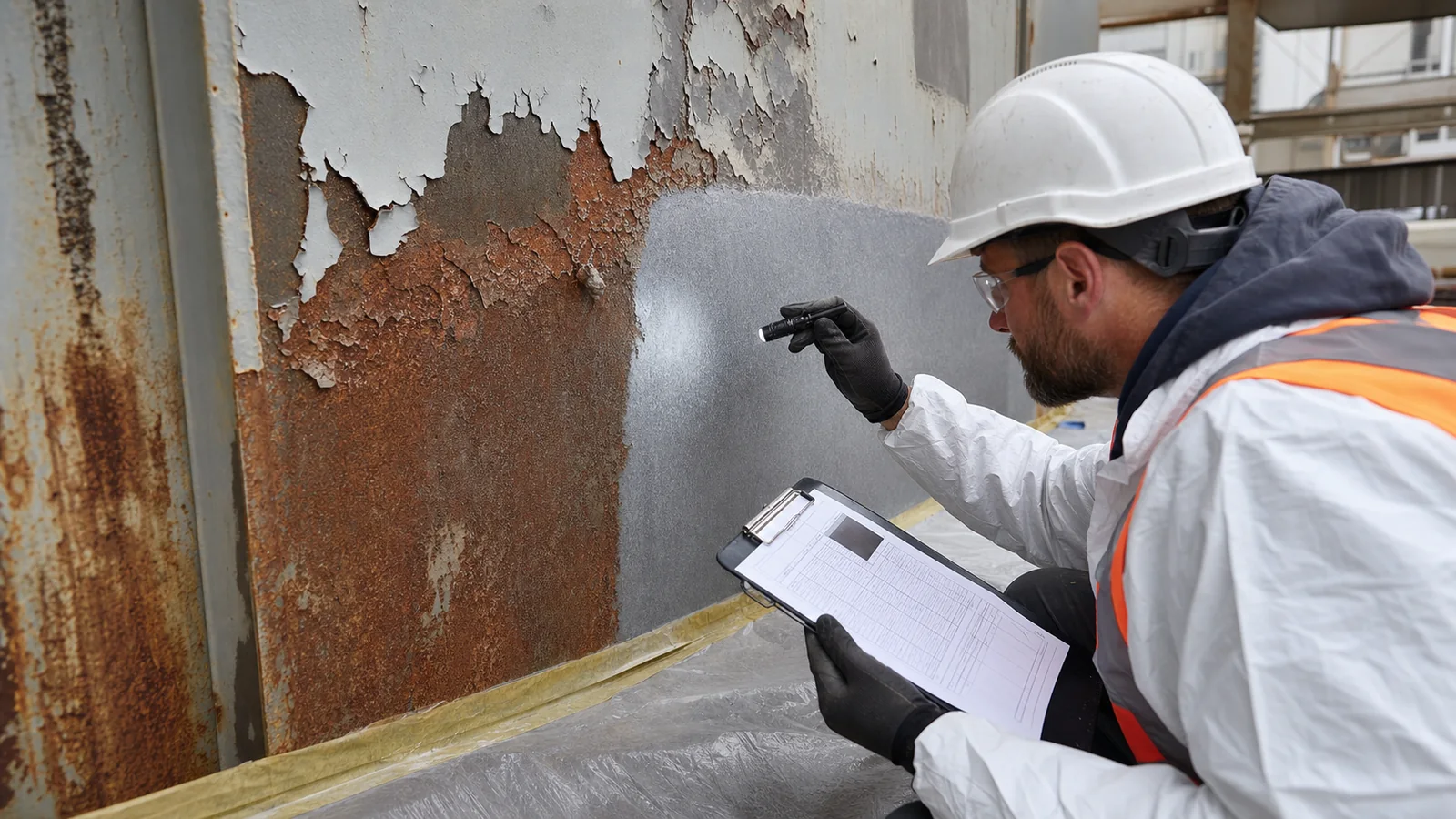
When a coating peels, blisters, flakes, or shows rust soon after application, it is easy to blame the paint. Sometimes the product or application is responsible, but many failures begin underneath: new material was applied over loose rust, failing paint, oil, mill scale, moisture, salts, or a surface texture that could not support adhesion.
Surface preparation before paint creates the condition the specified primer and topcoat need to bond and perform. The right preparation varies with the substrate, exposure, existing coating, and new system. Abrasive blasting can help, but it should be verified against project requirements rather than treated as universal.
Why the Surface Matters as Much as the Paint
A coating only bonds to what it touches. If that layer is weak, contaminated, or poorly profiled, the new system may release with it. Painting over rust does not necessarily stop corrosion, and covering a failing coating does not restore its attachment to the substrate.
Preparation has several possible jobs: remove unsound material, eliminate contaminants, establish a specified degree of cleanliness, and create or preserve the correct surface profile. Those jobs must be defined before work starts. A thin finish coat may require a different profile than a heavy protective lining; concrete and masonry have different acceptance criteria from steel.
The coating manufacturer’s current technical data and project specification should govern cleanliness, profile, moisture, contaminants, environmental conditions, primers, and timing. A surface that looks clean is not proof that every requirement has been met.
Problems That Must Not Be Sealed Under a New Coating
Common conditions that interfere with coating performance include:
- Loose rust and corrosion products: New paint can detach as the unstable layer continues to release.
- Old failing paint: Peeling, chalking, or poorly adhered material creates a weak foundation even if some areas still look intact.
- Oil and grease: Surface films can prevent wetting and adhesion; deeply absorbed contamination may require more than mechanical preparation.
- Mill scale: This manufacturing layer can separate from steel and take an overlying coating with it.
- Moisture and condensation: Water beneath or on a coating can contribute to blistering and poor adhesion.
- Soluble salts or process residue: Contaminants can draw moisture or promote corrosion beneath an apparently sound film.
- Dust and spent abrasive: Residue left after preparation can become the weak layer between substrate and primer.
Existing coatings should be identified when practical. Older or industrial coatings may contain lead, chromium, or other hazardous constituents. Appropriate testing, exposure controls, containment, waste characterization, and disposal must be planned before disturbance. Wet abrasive blasting can reduce airborne dust, but water does not make hazardous coating debris harmless.
What Skipped or Incomplete Preparation Looks Like
Poor adhesion commonly appears as peeling or flaking. The coating may release from the substrate or pull away an older layer that was never sound enough to retain. Rust bleed-through can indicate remaining corrosion, contamination, inadequate coverage over profile peaks, or a breach that allowed moisture to reach steel.
Bubbling and blistering have several potential causes, including trapped moisture, osmotic effects from contaminants, application outside environmental limits, or vapor pressure through a substrate. Preparation alone cannot correct active water intrusion, structural movement, or every moisture problem. Those conditions need diagnosis by the appropriate coating, engineering, or building professional.
Premature failure can require coating removal, another operational interruption, and additional substrate repair. No prep method can promise an exact service life or savings, but removing known weak layers and meeting the coating specification reduces preventable failure risk.
Why Blasting Differs From Basic Hand-Tool Prep
Wire brushing, sanding, needle scaling, and grinding can suit localized work, welds, repairs, or specifications that permit them. However, access, operator variability, and complex geometry can make a uniform result difficult across a large asset.
Abrasive blasting propels media to cut or dislodge coating and corrosion. On compatible substrates, it can clean edges, corners, welds, pits, and irregular shapes while creating an anchor profile for mechanical adhesion. Abrasive type, particle size, pressure, nozzle distance, angle, dwell, and water flow all influence the result.
Blasting is not inherently superior for every project. Aggressive settings can distort thin steel, erode soft masonry, expose aggregate, or create more profile than a coating can cover. Sensitive components require masking or removal. A representative test patch should confirm the lowest effective setup and provide an acceptance benchmark.
Wet abrasive blasting suppresses much of the airborne dust generated at impact, which may improve visibility and reduce drift on outdoor jobs. It is not dust-free, and it produces damp abrasive, water, and removed coating that require containment and recovery. Dry blasting, power tools, chemical stripping, or another method may fit better where water is unacceptable or the substrate is especially sensitive.
Define the Required Finish Before Work Begins
“Remove the rust” or “get it ready for paint” is too vague for a reliable handoff. Before mobilization, the owner, preparation contractor, coating contractor, and inspector should align on measurable or visible acceptance criteria.
A useful pre-job checklist includes:
- identify the substrate, existing coating, repairs, and visible contamination;
- review coating records and arrange hazardous-material testing when warranted;
- confirm areas requiring full removal versus sound coating allowed to remain;
- state the specified cleanliness standard and anchor-profile range;
- decide who performs profile, salt, dust, moisture, or adhesion testing;
- mark exclusions such as bearings, seals, instruments, labels, and finished surfaces;
- define containment, drain protection, residue recovery, and waste responsibilities;
- identify repair work that must occur after preparation;
- establish who accepts the surface and how quickly primer must follow.
A test area should represent normal and difficult conditions—not only the easiest open section. Include typical coating thickness, corrosion, edges, or repairs. Record the method and settings, then have the person authorized to accept the coating substrate review the result.
A Reliable Blast-to-Coating Workflow
The strongest workflow connects preparation directly to coating rather than treating them as unrelated tasks.
1. Inspect and diagnose. Document corrosion, coating failure, contamination, access, geometry, and substrate defects. 2. Protect and contain. Isolate the work, shield excluded components, protect drains and adjacent property, and prepare to collect residue. 3. Remove contamination as required. Oil, grease, salts, or other material may need cleaning before or after mechanical preparation under the specified procedure. 4. Prepare to the accepted benchmark. Use the approved method and adjust carefully as coating thickness, corrosion, or geometry changes. 5. Clean and dry. Remove spent abrasive and residue. Wet-prepared surfaces require adequate drying, especially before priming carbon steel. 6. Inspect and test. Compare with the accepted sample and complete required profile, cleanliness, or contaminant checks. 7. Repair and reprepare where needed. Address exposed defects, then restore repaired or contaminated areas to the required condition. 8. Prime within the approved window. Protect the surface from rain, condensation, traffic, dust, and flash rust until coating is applied.
Environmental readings matter. Steel temperature, air temperature, relative humidity, and dew point can determine whether preparation or coating should proceed. The coating crew should make its own acceptance decision rather than assuming the end of blasting automatically means the start of painting.
Planning Surface Preparation in Kansas, Oklahoma, and Texas
Mobile preparation can reduce transportation of large assets, but field conditions become part of the plan. Across Kansas, Oklahoma, and Texas, wind affects containment; heat influences drying and coating application; humidity and weather shifts can increase condensation or flash-rust risk. Sequence work in sections that can be inspected and protected promptly.
At active facilities, coordinate traffic, people, air intakes, electrical equipment, and neighboring operations. Water, drainage, access, and collection space can determine whether wet abrasive blasting is practical. Complex scopes may require a site visit.
Frequently Asked Questions
Does all old paint have to be removed before repainting?
Not always. Some specifications allow tightly adhered, compatible coating to remain after cleaning and feathering; others require complete removal. Adhesion, compatibility, exposure, and the new system’s requirements should determine the scope.
Is abrasive blasting always the best preparation method?
No. The appropriate method depends on substrate, coating, access, target profile, environmental limits, and site controls. Blasting, power tools, washing, chemical removal, or a combination may be specified. Test patches help verify suitability.
Can wet abrasive blasting prevent flash rust?
No. Newly exposed carbon steel can flash rust after wet preparation. Water quality, weather, drying, inspection timing, and prompt priming matter. Use an inhibitor only when the coating manufacturer and project requirements permit it.
How long can prepared steel wait before primer?
There is no universal safe interval. Prime within the coating specification’s approved window and before rust, condensation, dust, or other contamination changes the accepted surface. Weather and site exposure can shorten the practical window.
Share Your Coating-Prep Scope
Manases EcoBlast provides mobile surface preparation from Great Bend, Kansas, and Austin, Texas, for projects across Kansas, Oklahoma, and Texas. Send photos, approximate dimensions, substrate and coating information, the intended coating system, project ZIP code, access notes, and target schedule to contact@manasesecoblast.com, or call 512-592-1288. With that information, the team can discuss testing, containment, preparation criteria, and a practical coating handoff without assuming one method fits every surface.