
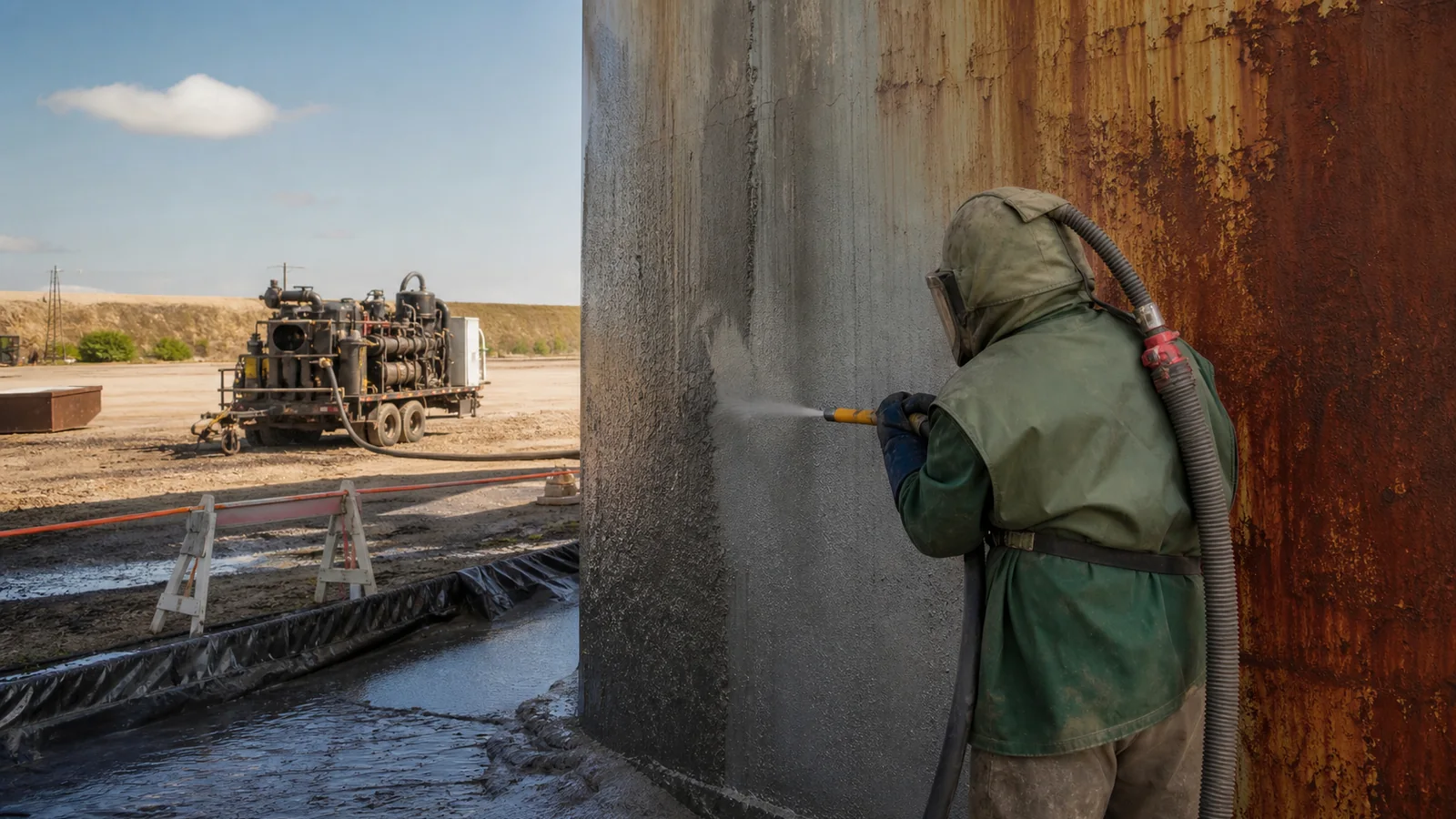
Commercial dustless blasting is often requested when a facility, fleet, or construction team needs to remove coatings and corrosion without producing the same airborne dust profile associated with dry blasting. The common industry phrase can be misleading: the process is not dust-free. It typically combines water, abrasive media, and compressed air to reduce airborne dust while cleaning and profiling a surface.
For project managers, the important question is not whether one method sounds cleaner. It is whether the proposed process fits the substrate, coating system, work area, schedule, and finish specification. A productive scope starts with those details and treats blasting as one part of a larger surface-preparation plan.
What Commercial Dustless Blasting Does
Wet abrasive blasting propels abrasive media in a water stream. The abrasive performs the cutting action, while water suppresses a substantial portion of the airborne particulate. Depending on the selected media and operating settings, the process can remove paint, scale, oxidation, residue, and failed protective coatings from steel and other durable surfaces.
Commercial applications may include structural components, tanks, trailers, machinery, agricultural equipment, concrete, masonry, and fabricated assemblies. Suitability still depends on the specific material. Thin sheet metal, delicate details, unknown composites, and surfaces near sensitive components may require lower pressure, a different abrasive, a test area, or another preparation method.
Blasting also changes the surface. On steel, that often means creating an anchor profile that helps a compatible coating bond. The required profile should come from the coating manufacturer or project specification—not from a generic assumption that a rougher surface is always better.
Start With the Existing Coating and Substrate
Before selecting equipment, document what is being removed and what lies beneath it. A heavy elastomeric coating behaves differently from brittle paint, and tightly bonded mill scale differs from loose rust. Multiple coating layers can also respond at different production rates.
If the coating composition is unknown, the owner or general contractor may need appropriate testing before work begins. Lead or other regulated constituents can change containment, worker protection, waste handling, and disposal requirements. Water does not make hazardous material harmless, and reduced dust does not remove compliance obligations.
Substrate condition matters just as much. Record corrosion depth, pitting, cracks, previous repairs, welds, and thin areas. Blasting reveals defects; it does not restore lost metal or correct structural damage. Marking vulnerable parts and creating a hold point after cleaning gives the owner an opportunity to inspect before coating proceeds.
Plan Access, Containment, and Utilities
A mobile blasting crew needs safe equipment access, room for hoses, a stable operating area, and a practical route around the work. Commercial teams should identify gate widths, overhead restrictions, traffic patterns, occupied spaces, nearby vehicles, finished surfaces, and active operations. Photographs and a simple site plan can answer many questions before mobilization.
Wet abrasive blasting reduces airborne dust, but spent abrasive, coating debris, and water still need control. Containment may range from ground protection and localized screening to more extensive enclosures, depending on the site and material being removed. Storm drains, soil, adjacent tenants, food-processing areas, instrumentation, and energized equipment deserve specific attention.
Confirm water availability, electrical constraints, working hours, noise limits, and whether operations can be isolated. In Great Bend, Austin, and work sites across Kansas, Oklahoma, and Texas, weather also affects planning. Wind can move mist and debris, while freezing temperatures, high heat, or thunderstorms can alter safe working windows.
Match Media and Settings to the Finish Requirement
Abrasive choice affects cutting speed, profile, cleanup, and substrate risk. Garnet, recycled glass, and other media each have different hardness, shape, density, and available gradations. The right selection depends on the coating, base material, desired profile, and site controls.
Pressure, water flow, nozzle distance, and dwell time matter alongside media. An experienced operator adjusts the complete system instead of relying on one universal setting. A test patch is especially useful when the surface is unfamiliar, appearance is important, or the coating specification defines a narrow profile range.
Agree on an acceptance standard before production begins. Examples may include a referenced visual cleanliness standard, a specified anchor-profile range, or an approved sample area. Clear criteria reduce subjective disputes after the surface has been cleaned.
Coordinate Blasting With Coating Work
A prepared surface begins changing as soon as blasting ends. Bare carbon steel is especially time-sensitive because moisture and ambient conditions can contribute to flash rust. The project plan should connect blasting capacity with inspection, drying, cleanup, and primer application.
Wet blasting does not automatically prevent flash rust. Water quality, surface contaminants, humidity, temperature, dwell time, and the selected coating system all influence the next step. Any corrosion inhibitor or cleaning additive must be compatible with the specified primer and approved by the responsible coating party.
Build the schedule around manageable sections. Define who verifies cleanliness and profile, who authorizes repairs, who provides coating materials, and what happens if weather closes the application window. This coordination is often more important than the theoretical daily production rate.
Mobile Service Versus a Fixed Blasting Facility
The legacy Eco-Blast article compared mobile and fixed blasting systems because location changes the entire project plan. Mobile equipment brings the work zone to an asset, facility, fleet yard, or construction site. That can avoid hauling a large trailer, machine, tank component, or fabricated assembly. It also lets an owner phase several assets around operations.
Mobility does not eliminate site requirements. A workable mobile location needs equipment access, hose routes, stable setup space, an exclusion zone, containment, cleanup access, and controls for wind, drains, traffic, adjacent property, and active operations. Weather and local working-hour restrictions may shape production.
A fixed blasting facility can offer a controlled enclosure, established recovery systems, and repeatable conditions. It may fit smaller transportable parts, production batches, or work that requires a dedicated blast room. Transportation, loading, disassembly, part dimensions, and the facility's accepted coating or material limits still affect feasibility.
Neither approach is universally more powerful, economical, or precise. The useful comparison is the complete workflow: move the blasting system to the asset, or move the asset to a prepared facility. Asset size, transport risk, site sensitivity, work volume, required controls, and the next trade determine the better fit.
Compare the Full Project Economics
A low hourly rate does not necessarily create the lowest completed cost. Commercial teams should compare mobilization, production, masking, containment, access equipment, cleanup, waste handling, inspection, repair delays, and the coating handoff. Downtime can outweigh nozzle time when a trailer, machine, bay, or production area must remain out of service.
Wet abrasive blasting may reduce some airborne-dust controls and housekeeping compared with a dry method, but it still produces water, spent media, and removed coating that must be managed. Dry blasting may provide advantages for a particular specification or controlled facility. Manual tools may be economical for small isolated areas but slow across complex geometry. A test patch helps estimate actual removal rate and finish more credibly than a generic square-foot assumption.
For fleets or repeated components, a pilot asset can improve the budget. Record disassembly, protection, abrasive settings, time by section, inaccessible areas, cleanup volume, inspection findings, and painter feedback. The remaining units can then be sequenced with better evidence instead of treating every asset as an unknown first job.
Industry Use, Technology, and Compliance
Automotive restoration, fleet maintenance, fabrication, manufacturing, construction, infrastructure, marine work, and historic restoration all use abrasive surface preparation in different ways. The common requirement is control: the method must fit the substrate, coating, required profile, work environment, and finish that follows. A process suitable for heavy structural steel may be inappropriate for thin sheet metal, soft masonry, or a delicate historic surface.
Equipment continues to improve through more precise metering, better moisture control, portable systems, monitoring, and task-specific media. Those developments do not replace operator judgment or project specifications. Automated or fixed systems may help repetitive production, while mobile units solve access and transport problems. A modern machine cannot make an unsuitable scope safe by itself.
Compliance belongs in planning rather than in marketing language. Reduced airborne dust does not remove obligations involving worker exposure, hazardous coatings, wastewater, spent abrasive, noise, or waste disposal. Requirements depend on the material, site, jurisdiction, and responsible parties. Unknown coatings may need testing, operators need suitable training and PPE, and the project team should define containment, emergency procedures, and waste responsibility before work begins.
Build a Clear Commercial Scope
Useful bid documents describe quantities and constraints rather than asking for a broad price to “blast everything.” Include dimensions, approximate square footage, component counts, current photos, known coating history, substrate type, desired finish, and the next coating system. Note difficult geometry, interiors, undersides, elevated areas, and obstructions.
The scope should assign responsibility for masking, disassembly, access equipment, containment, water, cleanup, waste characterization, hauling, inspection, and coating. It should also state the operating schedule and any required coordination with other trades. These details help vendors compare the same work and reduce change-order risk.
For multi-site programs, provide a location list and identify which assets can be grouped. Mobilization planning across KS, OK, and TX may influence the sequence even when each individual asset is similar.
Frequently Asked Questions
Is dustless blasting actually dust-free?
No. Wet abrasive blasting uses water to reduce airborne dust, but it can still create mist, particulate, coating debris, and spent abrasive. Site controls and appropriate personal protective equipment remain necessary.
Can commercial dustless blasting prepare steel for paint?
It can, when the abrasive, operating settings, cleanliness, and anchor profile match the coating specification. The freshly prepared steel also needs timely inspection and coating to manage contamination and flash rust.
Can work occur while a facility remains open?
Sometimes, but it depends on separation from employees and customers, traffic control, noise, overspray risk, debris control, and the facility’s operations. Phased work or temporary shutdowns may be the safer and more efficient choice.
Is mobile blasting better than using a fixed blast facility?
Not automatically. Mobile service can avoid transporting large or disabled assets and can phase work at a yard or facility. A fixed enclosure may better suit transportable parts, repeated production, or a tightly controlled environment. Compare transport, access, containment, volume, weather, and the coating handoff.
What information helps produce an accurate scope?
Send current photos, drawings or a simple plan, the project ZIP code, estimated dimensions or square footage, substrate and coating details, access restrictions, desired finish, and target timeline. Mention any known hazardous-material testing or sensitive nearby operations.
Plan Your Commercial Blasting Project
Manases EcoBlast supports commercial teams from Great Bend and Austin across Kansas, Oklahoma, and Texas. To discuss a facility, fleet, equipment, or construction scope, send photos, plans, the project ZIP code, estimated size, and desired timeline to contact@manasesecoblast.com or call 512-592-1288. Those details allow the team to review access, surface conditions, containment needs, and the intended finish before the next planning step.