
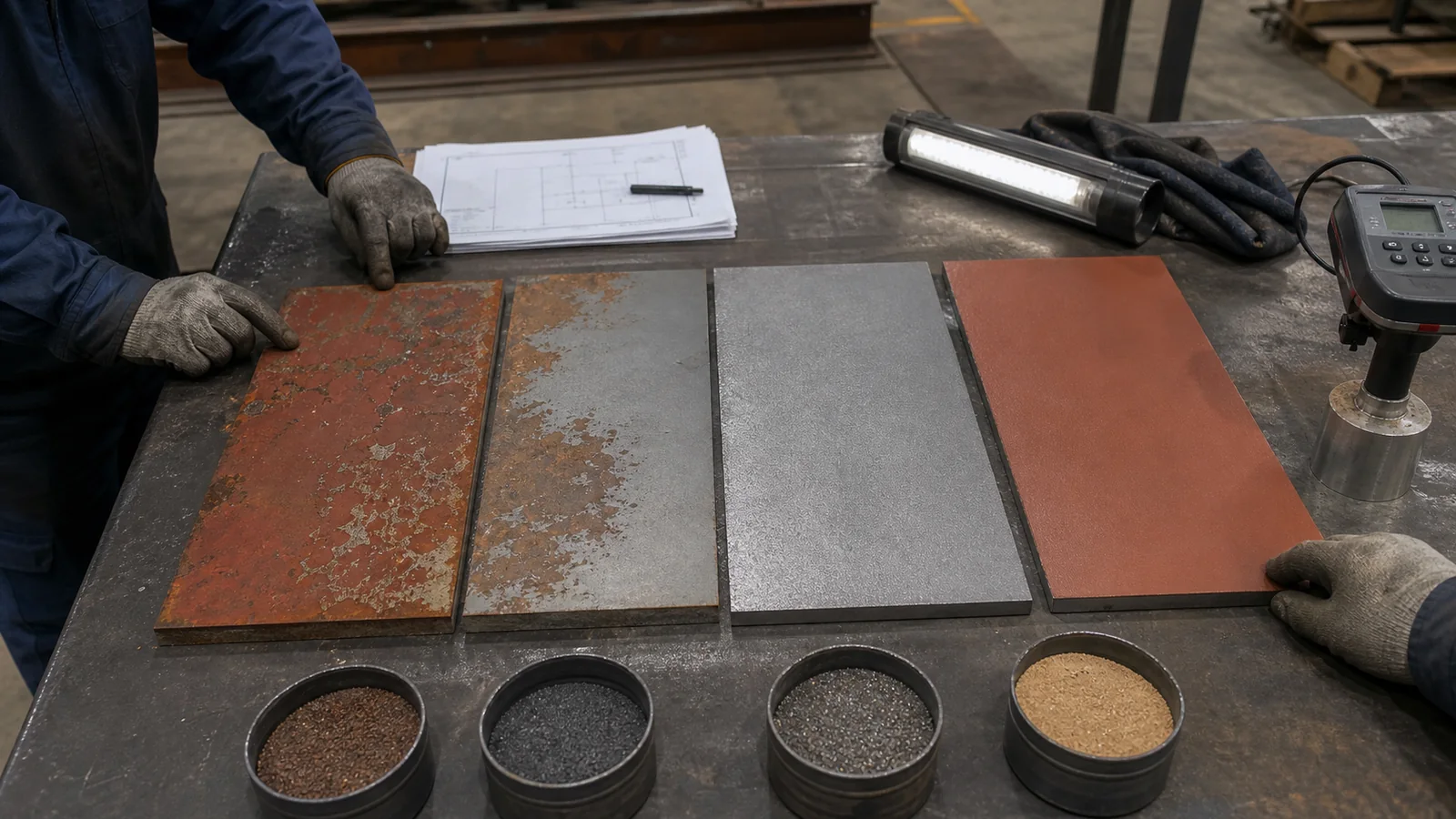
Choosing blasting media is not simply a matter of selecting the most aggressive abrasive. Media affects coating-removal speed, anchor profile, substrate condition, consumption, visibility, cleanup, and the volume of spent material. On a commercial project, the right choice must work with the equipment and also support the coating specification, site controls, and production plan.
Abrasive names alone do not predict the result. Particle size, shape, hardness, density, operating pressure, water flow, nozzle distance, and operator technique all influence how a surface changes. The most reliable selection process starts with the required finished condition and works backward through the substrate and existing coating.
Define the Required Surface First
Before discussing media, determine what “done” means. Is the goal to remove a failed coating while preserving a sound layer beneath it? Does the steel need a specified visual cleanliness and anchor-profile range? Is the owner seeking a uniform architectural appearance on concrete or masonry? Different answers can require different abrasives and techniques.
When a new coating will follow, use its current technical requirements and the project specification. A thick protective lining may call for a different profile than a thin finish coat. Too little profile can impair mechanical adhesion; excessive profile can leave peaks insufficiently covered by the applied film thickness.
Define how the surface will be accepted. A reference standard, profile measurements, contamination testing, or an approved sample panel gives the field team an objective target. Without that target, a media recommendation is largely a guess.
Evaluate the Substrate and Its Vulnerabilities
Carbon steel tolerates preparation that could distort thin sheet, erode soft metal, or change detailed masonry. Material thickness, hardness, condition, edges, welds, repairs, and heat sensitivity should all be documented. Deeply corroded steel may retain visible pitting even after loose corrosion and coating have been removed.
Concrete and masonry require attention to surface strength and aggregate exposure. Aggressive media can open pores, round edges, or reveal aggregate. Wood, fiberglass, aluminum, and precision components introduce different risks. A small test patch helps establish the lowest effective aggressiveness while confirming the desired appearance.
Sensitive items should be removed or masked when feasible. Bearings, seals, polished rods, threads, glass, instruments, labels, and electrical components should not be treated as ordinary blast surfaces. Media choice cannot replace careful protection and nozzle control.
Compare Common Media Characteristics
Angular media generally cuts coatings and creates profile more readily than rounded particles. Harder media tends to cut faster and can produce a sharper texture, while softer media may be more appropriate when substrate preservation matters. Larger particles can create a deeper profile but may be less effective in tight geometry and can increase surface impact.
Garnet is an angular mineral abrasive often considered for steel preparation because it can cut efficiently and is available in multiple gradations. Recycled glass abrasive is also angular and commonly used in wet and dry applications. Its behavior depends heavily on mesh size and source consistency.
Glass bead is more rounded and is often associated with cleaning or producing a smoother, peened appearance rather than creating a sharp coating profile. Steel shot and grit are durable metallic abrasives used primarily in controlled recovery systems; shot is rounded, while grit is angular. Organic or specialty media may serve selective cleaning needs but are not universal substitutes for conventional abrasives.
Specifications and regulations may restrict particular materials. Crystalline silica exposure is a serious concern, and the colloquial word “sandblasting” should not be interpreted as a direction to use ordinary sand. Review the abrasive safety data, equipment compatibility, and project requirements before procurement.
Account for Wet Versus Dry Operation
A medium suitable for dry blasting is not automatically optimal in a wet abrasive system. Water changes flow behavior, visibility, dust generation, and waste handling. The abrasive must feed consistently through the selected equipment and produce the required finish at practical settings.
Wet abrasive blasting reduces airborne dust but does not eliminate it. The process creates a mixture of water, spent media, and coating debris that needs containment and collection. Particle density and size can affect where material settles and how easily it is recovered.
On bare carbon steel, wet work also raises the possibility of flash rust. Media selection is only one part of the response. Water quality, ambient conditions, drying, inspection timing, and coating compatibility all belong in the work plan. Any additive should be approved for the specified coating system.
Balance Production With Total Project Cost
Media price per unit is an incomplete measure. A less expensive abrasive may consume faster, remove coatings more slowly, generate more waste, or require extra cleanup. A higher-performing material may still be a poor value if it creates too much profile or cannot be reclaimed at the site.
Estimate the complete workflow: delivery, storage, loading, blasting productivity, containment, collection, disposal, inspection, and rework risk. Complex assets such as frames, piping, tanks, and equipment have geometry that can matter more than open-area production figures.
Commercial buyers should also consider availability near the work. Projects across Kansas, Oklahoma, and Texas may face different supply distances and staging constraints. Confirm that the selected grade can be delivered consistently throughout the schedule rather than approving a one-time sample that cannot be reproduced.
Use a Test Patch and Document the Settings
A representative trial is the most direct way to evaluate media. Choose an area with typical coating thickness, corrosion, geometry, and substrate condition. Record the media type and gradation, approximate operating range, water setting if applicable, nozzle arrangement, and observed production.
Inspect more than cleanliness. Check profile, substrate distortion, edge retention, embedded particles, appearance, and cleanup behavior. If coating will follow, the responsible party should confirm that the trial surface meets the system requirements.
Once accepted, document the sample and settings as a production baseline. Operators will still make adjustments as conditions change, but a baseline improves consistency between shifts and assets. It also provides a clear reference if replacement media from another lot behaves differently.
Frequently Asked Questions
What is the best blasting media for rust removal?
There is no single best abrasive. The right media depends on the steel thickness, rust condition, required profile, equipment, and whether blasting is wet or dry. Angular mineral abrasives are common options, but a test patch should verify performance.
Does finer media always protect the surface?
No. Finer particles may create a shallower profile at comparable settings, but pressure, hardness, shape, dwell time, and nozzle distance also affect damage risk. Delicate substrates require control of the entire process.
Can one abrasive be used on every part of a project?
Sometimes, but mixed substrates or finish requirements may justify more than one grade or method. The team should avoid convenience-based substitutions that conflict with the coating specification or approved sample.
What information is needed to recommend media?
Provide photos, substrate and coating details, plans or component dimensions, the required finish or coating system, project ZIP code, access conditions, estimated size, and timeline. Existing test data and specifications are also valuable.
Get Input on a Commercial Media Plan
Manases EcoBlast serves commercial teams from Great Bend and Austin across KS, OK, and TX. To review an abrasive blasting scope, email photos, plans, ZIP code, estimated dimensions or square footage, and target timeline to contact@manasesecoblast.com, or call 512-592-1288. Sharing the substrate, existing coating, and intended finish helps the team frame a practical test and preparation approach.