
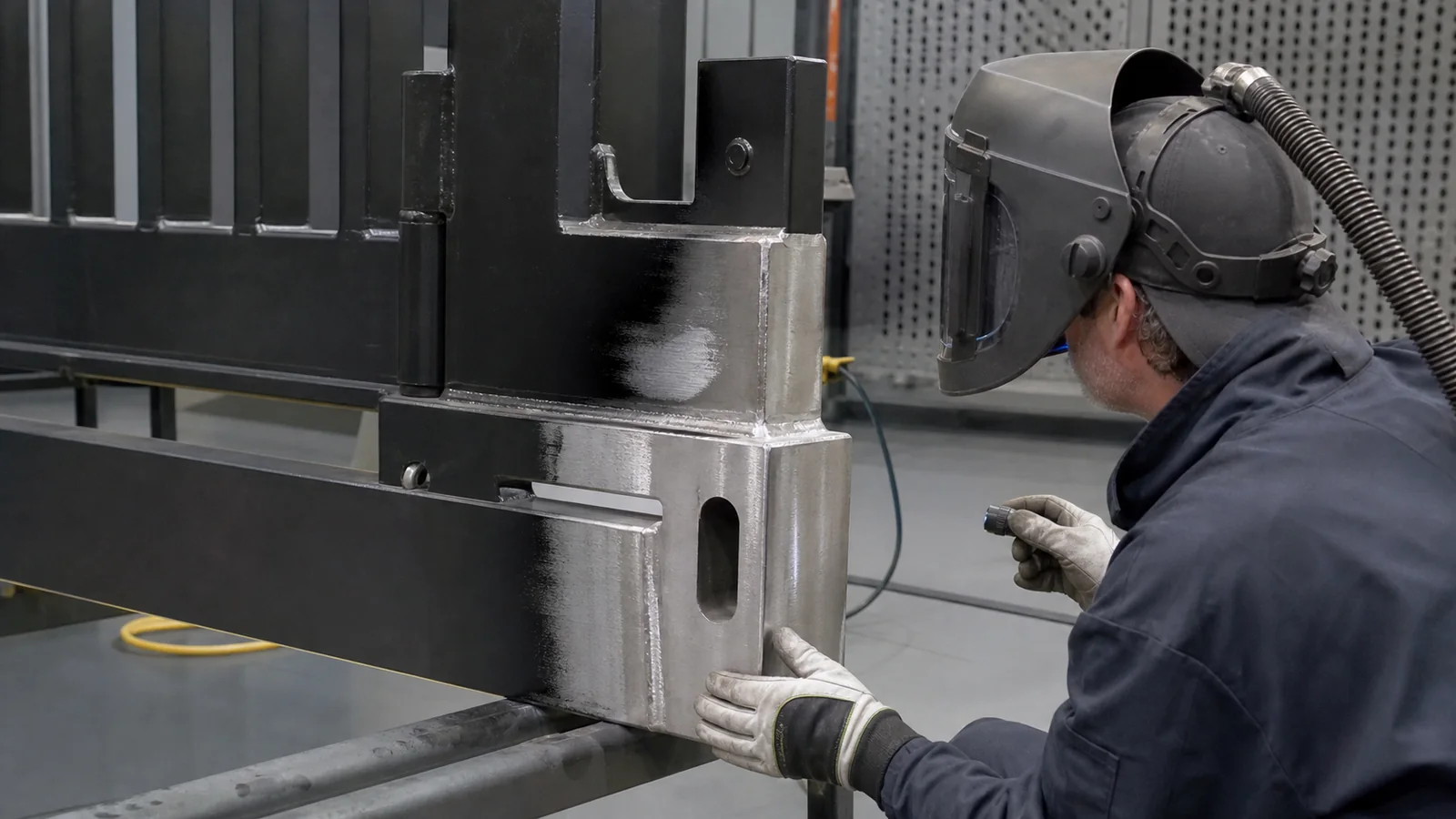
Powder coating is difficult to remove because durability is its purpose. Dry powder is electrostatically applied to conductive material and cured with heat, creating a continuous film that can resist chips, abrasion, and weathering. When that film fails—or when a part needs welding, repair, a new color, or a different coating system—the removal stage can determine whether the next finish has a reliable foundation.
The goal is not simply to make the old color disappear. A useful scope identifies the metal, coating, geometry, and new finish, then selects a method that leaves an acceptable surface. Aggressive work can distort thin steel, texture aluminum, or create the wrong profile. Incomplete stripping, residue, and delayed priming create other risks.
Owners, fabricators, fleet teams, and coating shops should plan removal and recoating as one coordinated process.
Why Powder Coating Requires Deliberate Removal
During curing, powder flows into a hard bonded layer. Formulation, thickness, age, and exposure affect removal. A decorative finish on aluminum may respond differently from a thick industrial system on steel. Multiple coats, repair paint, and corrosion add uncertainty.
Common reasons to remove powder coating include:
- peeling, chipping, chalking, or loss of adhesion;
- corrosion developing beneath or beside the film;
- welding, crack repair, or fabrication changes;
- a new color or complete refinish;
- conversion between paint and powder-coat systems; and
- inspection of metal hidden by a failed coating.
Before complete removal, confirm whether it is actually required. Some compatible systems may allow sound coating to remain after cleaning, abrasion, and feathering, while other specifications call for bare metal. The new coating supplier or applicator should define the acceptable condition. Painting over partially bonded powder coat without that review can preserve the original failure beneath the new finish.
Compare Removal Methods With the Part in Mind
No single method is best for every component. Chemical stripping can soften compatible formulations without creating an abrasive profile, which may help with intricate shapes. It introduces compatibility, rinsing or neutralization, exposure, residue, and waste concerns. Residue in seams can interfere with adhesion.
Specialized facilities can thermally strip some heavy coatings. Temperature must suit the alloy, heat treatment, dimensions, and part function. Thin sections may distort, and residue still requires cleaning.
Sanding and power tools suit small repairs, but full removal is slow around corners, welds, and recesses. Tool marks can affect the next coating.
Abrasive blasting can remove durable film while cleaning corrosion and creating a surface profile. It reaches complex geometry more consistently than flat sanding, but settings and media must be tuned. It may not be appropriate for every thin, soft, high-tolerance, or appearance-critical part. A test patch helps compare removal rate, substrate change, and finished texture before production.
Identify Metal, Coating, and Sensitive Features
Distinguish carbon steel, galvanized steel, stainless steel, and aluminum; appearance alone is insufficient. Alloy and thickness influence distortion and profile risk. Aluminum is generally easier to roughen than structural steel. Thin sheet, threads, bearing seats, sealing surfaces, identification marks, and mating faces need protection or another process.
Document coating thickness, condition, corrosion, repairs, and geometry. Unknown or older coatings may require testing before disturbance. Wet abrasive blasting reduces airborne dust but is not dust-free, and water does not neutralize hazardous constituents. Findings can change containment, protection, recovery, and disposal.
Also identify grease, oil, silicone, cutting fluid, road residue, and soluble contamination. Blasting is not a substitute for appropriate degreasing; it can spread oily material across the surface or drive it into crevices. Pre-cleaning requirements should come from the coating system and project specification.
Use a Test Area and Define Acceptance
A representative test area should include typical film buildup, an edge or weld, and any corrosion rather than only a broad flat panel. The operator can adjust abrasive type and size, pressure, nozzle distance, angle, water flow where used, and travel speed. The test should answer both removal and recoat questions:
- Does the coating release at a practical rate?
- Is sound metal being unnecessarily removed?
- Does the part stay flat and dimensionally suitable?
- Is the resulting anchor profile within the new coating’s range?
- Are recesses, edges, and welds accessible?
- Does the surface reveal pitting, cracks, or repair needs?
- Is a second method needed for protected or high-tolerance areas?
The owner, blaster, and coating applicator should agree on acceptance. That may mean complete removal and a specified profile, or localized removal with approved feathered transitions. “Ready to paint” is too vague on its own. For appearance-critical pieces, approve a sample through the actual primer and topcoat if practical; texture that looks minor on bare metal can remain visible under the finish.
Plan the Work Zone and Protect the Component
Mobile blasting needs stable access, safe hose routing, separation, and a recovery plan. Mask or remove bearings, seals, rods, connectors, glass, threads, data plates, and machined surfaces. Assign disassembly and reassembly.
Wet abrasive methods suppress much of the airborne dust but can produce mist, runoff, spent media, and coating chips. Wind, drains, nearby vehicles, occupied shops, sensitive equipment, and adjacent properties affect containment. Dry blasting has its own dust-collection and enclosure needs. The coating and any test results should guide controls rather than the marketing name of the process.
For owners preparing a request, assemble:
- Photos from all sides, including close-ups of failure and tight geometry.
- Part count, dimensions, estimated weight, and metal type.
- Known coating products, age, and available test results.
- Features that must not be blasted or altered.
- Desired removal boundary and surface/profile standard.
- New primer or powder system and the applicator’s requirements.
- Site ZIP code, access conditions, handling equipment, and timeline.
This information is more useful than asking for a generic per-part price. Quantity, coating thickness, rust, geometry, substrate, containment, handling, travel, and acceptance criteria all affect effort.
Coordinate Inspection, Handling, and Recoating
Inspect the exposed component before coating. Powder film can hide pits, cracks, failed welds, and filler. Blasting reveals defects but does not repair them or establish fitness for service; qualified personnel should determine the response.
Bare carbon steel is time-sensitive and can rust quickly under unfavorable conditions. Wet-prepared steel can develop flash rust. Plan removal close to inspection and primer application, using manageable batches the coating crew can accept. Do not leave stripped steel exposed for days based on a universal assumption; follow the coating specification and actual surface and ambient conditions.
Keep prepared material clean and dry, using supports and handling that limit oil, dust, and shop contamination. Aluminum needs a compatible preparation and primer system. Edges, pits, and welds need coating attention because film commonly runs thin there.
Avoid the Failure Cycle
Many early recoat problems begin at handoff rather than during removal. Preventable mistakes include leaving loose boundaries under new paint, failing to remove chemical residue or blast dust, applying an incompatible primer, allowing prepared steel to rust, and contaminating parts during transport. Another common error is coating the broad faces while leaving edges, welds, or recesses underprotected.
Build the sequence backward from coating day. Confirm materials, application space, weather or oven capacity, inspection availability, repair authorization, and cure time before stripping a large batch. If the first part differs from the assumptions, pause and revise the process instead of repeating the mismatch across every item.
A removal job is successful when it delivers a documented, acceptable substrate to the next trade—not merely when the old powder is gone.
Frequently Asked Questions
Can powder coating be blasted off aluminum?
Sometimes, but aluminum can be etched, textured, or dimensionally affected more easily than robust steel. Media, settings, geometry, alloy, thickness, and final appearance all matter. Use a representative test area and coating-applicator acceptance.
Is blasting always faster than chemical stripping?
No. Productivity depends on coating chemistry and thickness, part shape, quantity, substrate, containment, and finish requirements. Chemical, thermal, abrasive, manual, or combined methods may be preferable for different parts.
Must every trace of powder coat be removed before repainting?
Not necessarily. The new coating specification may permit firmly bonded, compatible material to remain after proper preparation. Failed or incompatible coating should not simply be buried. Ask the coating applicator to define acceptance.
How soon should bare steel be primed?
As soon as the specification and conditions require, before rust or contamination makes it unacceptable. Humidity, surface temperature, wet versus dry preparation, handling, and primer requirements prevent one fixed answer.
What determines powder-coat removal cost?
Part size and quantity, film thickness, corrosion, metal type, geometry, masking, access, containment, cleanup, travel, and the required finished condition all contribute. Photos and a clear recoat specification support a more useful review.
Request a Powder-Coat Removal Review
Send Manases EcoBlast photos, dimensions and quantity, metal type, known coating information, sensitive features, intended new finish, project ZIP code, and timeline. Call 512-592-1288 or email contact@manasesecoblast.com to discuss mobile powder-coat removal and metal surface preparation in Kansas, Oklahoma, or Texas. Coordinating the removal standard with your coating applicator before work begins helps the team evaluate a suitable test and handoff plan.